Labels

Thursday, 7 May 2015

Evaluation Q5

5. How did you attract/address your audience?

 Our target audience is young people of either gender aged between 15 to 25 (For this reason and research on the bbfc website we gave our film a 15 age rating). They would likely lead active lifestyles due to their age and would enjoy cinema. Once we had decided on our audience we questioned people who matched up to our target audience on what they would expect and like to see in our film.
Due to our research and our target audience we decided to make our protagonist a young teenager themself in order to make them relatable and therefore more appealing to our audience. We used an actor who was a teenager themselves so our Chris character looked realistic which we reinforced through his code of dress. We had the character dress in trendy clothes that a teenager would wear these days.


We then showed our film once completed to a few people who matched our target audience. All of them said that the Chris character was relatable and looked like a modern day teenager. The majority said that the settings looked "scary" and found the film to be tense and suitable for the psychological thriller genre. One person however said that the characters dialogue was unrealistic and that transition from the woodland area to the worksite seemed too sudden and unrealistic. In the future we would research more into dialogue used in psychological thrillers so it sounds more natural and realistic rather than forced. We would also consider looking at using transitions in order to make the transition from each setting more smooth. 

Evaluation Q4

Evaluation Q3

https://docs.google.com/document/d/1WNAUuWAZO5RDRzU5-4MxMpSDL2pE8pXxbKLWpyKfdYo/edit?usp=sharing

Evaluation Q2

2. How does your media product represent particular social groups?

 Our film challenges many stereotypes of particular social groups through the use of cinematography, sound, mise-en-scene and editing. 
 Throughout the 2 minute clip of our film we represent teenager and young adults as being vulnerable and also subvert gender stereotypes as they are all male and are being represented in this way . Chris is wearing clothes such as a shirt and tracksuit bottoms which is stereotypical of a teenager. This adds to the realism of the film which helps add tension. The man on the floor has fake blood on him which shows he is in danger and in need of help. Chris' dialogue throughout the clip consists of him asking for help and screaming which connotes his vulnerability. Also throughout the clip we used high angle shots to reinforce Chris' vulnerability. We also used a high angle shot on the bloodied up young adult to show he is vulnerable too. We also used paced editing as Chris is running away to add to the tension and reinforce Chris' vulnerability. The effect of everything above represents young people as being vulnerable. Also, often in the media, men are represented as being tough and brave whilst in our film our use of cinematography, sound, mis-en-scene and editing represent them as being weak and vulnerable. 
 Whilst there is no women at the beginning we planned on introducing female characters later on in the film through the role of care workers which is a stereotypically female job as women are stereotypically caring.

Evaluation Q1


1. In what ways does your media product use, develop or challenge forms and conventions of real media products?

We created our film to be a psychological thriller. Often psychological thrillers, such as The Shining, the antagonist starts out sane but as the story progresses something about the location or an event causes them to lose their sanity and become more dangerous to the protagonists. Our film conforms to this convention as our character Chris is traumatized by an event which causes him to lose his grip on reality. Our film, however, challenges the normal conventions of psychological thrillers as our character Chris is also the protagonist. 

Our narrative also subverts the genre conventions of psychological thrillers as our film starts by showing what is happening to our protagonist later on the film before a flashback starts the story back at the beginning so the audience can see what or who our protagonist is running away from.

Based on our research of the film Eden Lake, a psychological thriller, we decided to use the setting of a lake surrounded by woodland. The woodland and lake connote danger to the audience as there are plenty of places where danger could be lurking unseen. We also used the setting of an abandoned worksite. The large open area connotes vulnerability as the audience sees Chris is all alone with nobody to help him. Our final setting is that of a care home which also has connotations of vulnerability as our character Chris is obviously unable to look after himself which would make the audience sympathetic as they've just seen what he's gone through before the flashback. 

 In the first 2 minutes of our film we conformed to the genre conventions of psychological thrillers through our use of sound. We included the diegetic sound of waves at the beginning to keep our film realistic and to make the audience think about water as that is a theme throughout our film. We also used non-diegetic sound in the form of piano music playing in the background. The music builds up slowly which adds to the tension as the audience tries to work out who or what is after our protagonist. Another example of non-diegetic sound we used which conforms to genre stereotypes was a high pitched static sound. This signified a change from present time to the flashback. We also used a voice-over to help establish the narrative.
  
   Psychological thriller films often use a mixture of different types of shots in order to build tension. We used this in our film for the same effect. For example we used dolly shots to make the audience focus on the fear on Chris' face. We also used high angle shots on the bloodied up man to connote his vulnerability as he asks for help.


 We also used props through the use of fake blood. This is a typical genre convention of psychological thrillers as blood connotes danger and in the instance of our film, leaves the audience wondering what caused it thus adding to the tension.


Monday, 27 April 2015

Evaluation - Question 7

7. Looking back at your preliminary task, do you feel you have learnt in the progression from it to the full product?

What brief were you working to?
Our preliminary task involved filming two characters having a conversation, this began with one character sat in a room and the other walking inside the room, then sits down and has a conversation.
This meant that we had to cover the basics of filming such as; shot-reverse-shots, match on action, continuity and keeping to the 180 degree rule. This had to be then edited using Final Cut Express which helped us gain some experience before hand of our film.

Our preliminary task
Having learnt the four main rules to filming we ensured that we presented this through our preliminary video, this was so that we could show that we have understood and able to produce a film successfully. During filming we were all comfortable and successful with applying the 180 degree rule because we pictured a line across the centre of the chairs which helped us to stay within the boundaries. However, we had experienced slight difficulties during the filming process with match on action as our shots didnt seem to be continuous. The changes we made to improve this was adopting the method of freezing between shots so that they were continuous. This had improved our skills and knowledge as we knew how to work through difficult situations.

How did you use what you learned in the preliminary task in the 2 minute film?

Shot-reverse-shot: We used a shot-reverse-shot in our 2 minute film when a conersation merged between 'Chris' and the desperate, injured man. This method was used in order to achieve a more tense scene which is typical of our genre, over-the-shoulder shots were used to portray this.

Continuity: All three scenes in our film were continous shots which helped add to the effect of realism. However, we did break contuinity in our film and this was to show the difference in time by adding a jump cut. This was when Chris is taken back to the beginning to show the audience what happened to him and what lead to his death.

Match-On-Action: We had become moderately confident with doing this shot after having done this successfully in our preliminary task. We made good use of this in our full film where Chris runs through a fence, the match on action shot we produced made the overall output look professional whcih boosted our confidence in being able to do this.

180 Degree rule:  During filming we made an imaginery line accross the centre of Chris's view so that we could stay within bounds of the 180-degree line. If we hadn’t done this and we went over the angle, the film itself would not flow continuity and would not be edited coordinately. I also believe that if we had not trained these shots in the preliminary exercise, it would have been challenging to understand and shooting our 2-minute film wouldn't have been as successful and produced the film to a high standard.


What have i got better at?

The preliminary task itself gave us the opportunity to understand the basics of how to use the camera and the range of shots to create a continuity overall in the video. By experimenting these rules, we gathered our own weaknesses and strengths and depending on those we decided to focus on our weaknesses, and that’s the main reason why now we all individually feel like we can use a camera without any difficulty, use variety of shots to create a meaning in a video/film, use editing on final cut express to create continuity overall for the film, and in general be familiar with all the things we have used throughout this process.

We faced many challenges during our filming, such as deciding whether our 2 minute film should be a linear narrative or not, this was dependant on the way we also shot our film so was quite tricky until we made a clear and final decision. I now feel a lot more confident with using a camera to film things around me by using different techniques and methods in order to create a story. I could also use final cut express fluently to edit videos and create a film, as I originally didn’t have much knowledge about editing before the filming process.

Friday, 24 April 2015

Evaluation - Question 6

6. What have you learnt about technologies from the process of constructing this product?

Pre-production:
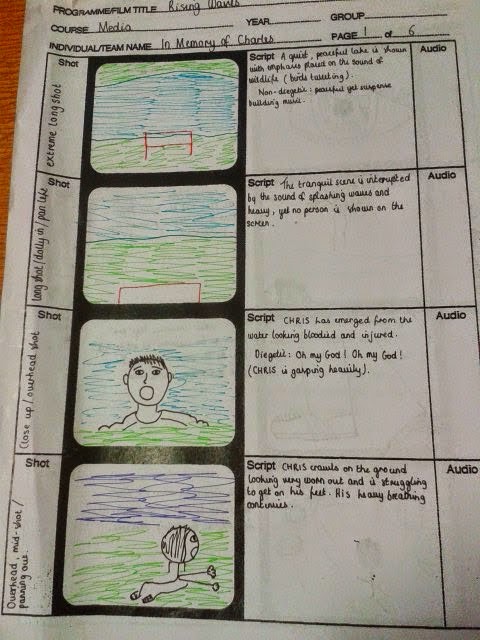
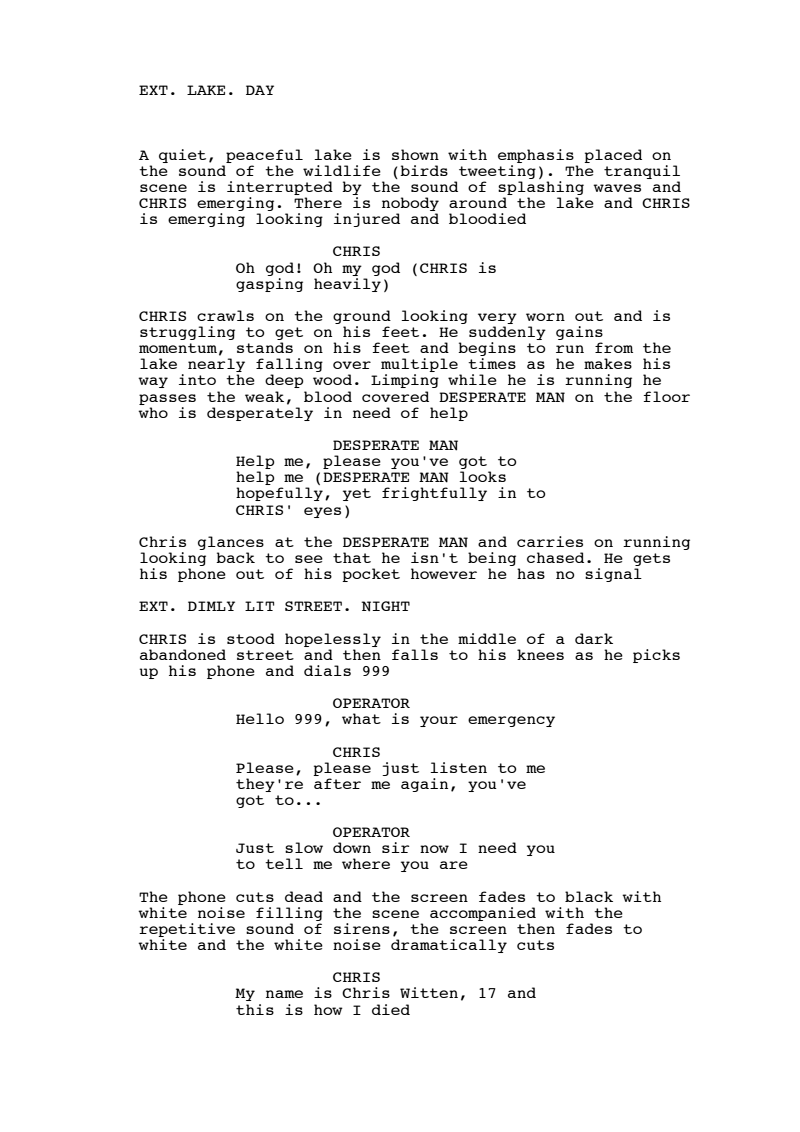
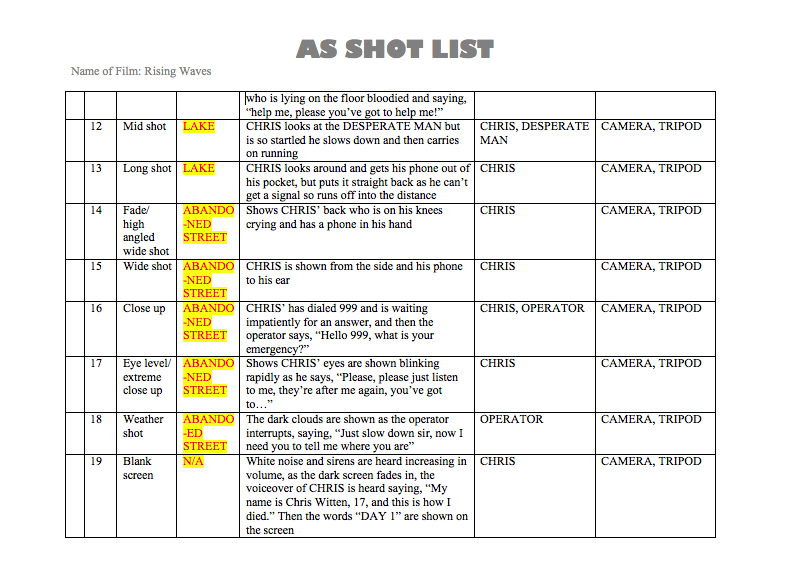
In our pre-production our main objectives were to plan how and where our film would be shot and also mainly what will be in our film, this meant that we had to come up with ideas. Firstly, we created a script using 'Celtex' this was very beneficial because it allowed us to easily format to different script types and has editing tools ensuring that the experience was simple and easy for us as users. Once the script was complete, it helped us gain different ideas that could be possibly used in our film. After this we created a pictured and quoted storyboard which was supposed to give a visual prediction around what our film will turn out to be like. An example of when this had helped us stay focused was; one day we had forgot how a shot should be took for a particular scene, at this point we referred back to the storyboard which helped us stay on track. We had used Blogger as a source for information to be shared within our group, we posted our research and made discussions around this easily and time effectively. Finally in our pre-production we created the shot list for our film, this contained information on every shot that will be taken for our film. The shot list contained information such as; the type of shot, angle, dialogue and equipment needed, this helped us effectively manage the time we had for each day of filming.


Production:
The filming for our film only took 4 days to produce, this was planned and set accordingly to each scene we had planned for each day. We used a Panasonic HD camcorder as this was known to be handy and effective producing high quality and resolution, this allowed us to benefit from being able to film in scenes that had low key lighting such as the abandoned street. We had used a range of shots during our filming, these include; close ups, extreme close ups, mid shots, establishing shots, POV shots, low angle and dolly shots. Most of our filming was used with the camcorder being attached to the tripod so that we had steady clear shots of the scenes. I think that after using the camera we had got more confident and believe this was a reason towards us being able to film a dolly shot, the dolly shot was produced with help from a wheelie chair and slight spread of ice on the ground as we did this for two scenes in our film.


Post-production: After we had completed all of our filming, we uploaded all the videos onto an Apple iMac so that it can be edited, to do this we used a software called Final Cut Express. This software enabled us to edit out film very easily as getting used to it was very simple having clear labels and icons displaying it's use. We were able to cut our video clips into certain lengths that we desired and had the option to add a variety of effects such as dissolve and fade. We were also able to cut videos and sounds apart which allowed us to insert the police officer's dialogue in the video of 'Chris' speaking on the phone, this made the scene look realistic as we were also able to change the frequency of the police officer's voice which output a realistic phone call. After we had completed all of our editing we uploaded our film onto YouTube and Blogger to be viewed.